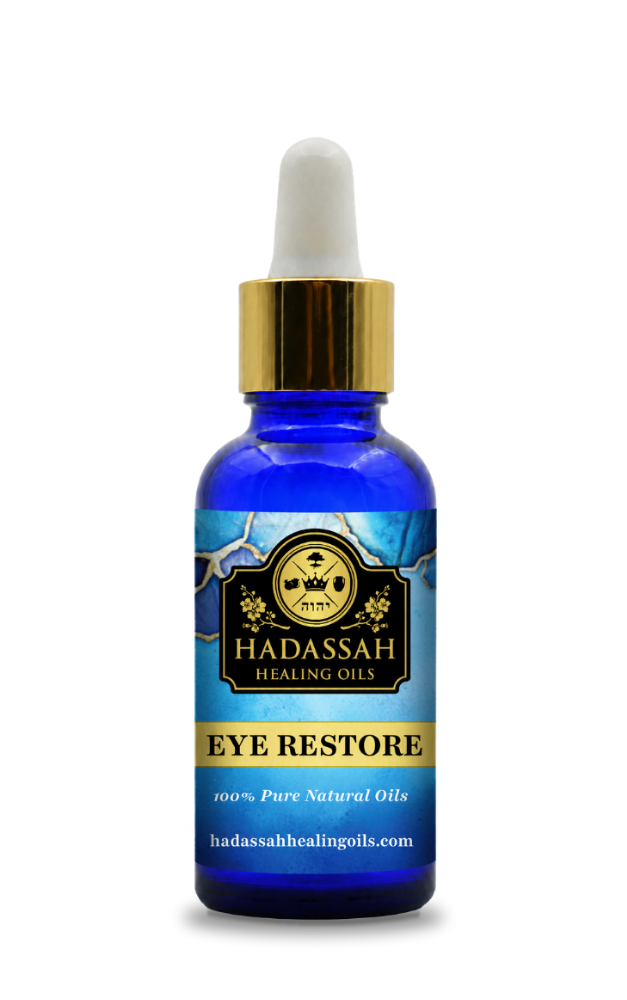
EYE RESTORE BLEND 30ML
R450.00 Incl. VAT
EYE RESTORE BLEND 30ML
This Eye Restore Blend helps to build up antioxidant levels in the body to increase blood flow and restore eyes and aids in healing. It also benefits nerve restoration.
In stock
- 100% Natural
- 100% Pure Essential Oils
- 100% Manufacturing Guarantee
- Share to social media
Description
Directions for Use
Warning
Ingredients
Technical Information
EYE RESTORE BLEND 30ML
The eyes are among the body’s most metabolically active organs. The retina, lens, optic nerve and other ocular structures depend on healthy cellular function, an adequate nutrient supply and protection against excessive oxidative stress.
Hadassah Healing Oils Eye Restore Blend brings together seven botanical ingredients selected for their distinctive chemical compositions and their relevance to research involving antioxidants, inflammatory signalling and cellular biology.
The formulation combines aromatic plant constituents with lipid-rich botanical oils, providing a complex mixture of terpenes, phenolic compounds and fatty acids.
These substances are scientifically interesting because oxidative stress and inflammation contribute to several processes involved in ocular ageing and disease.
We do suggest using this blend with our full Eye Sight Restore Protocol.
EYE RESTORE BLEND 30ML
DO NOT insert into the eyes.
Eye Restore Blend is not intended for application in or around the eyes.
It must never be placed directly into the eyes, used as eye drops or applied to the eyelids.
Drink 1 capsule of the Eye Restore; and 1 capsule of the DNA Protector, daily.
Daily apply a few drops of this blend on the back of the neck and behind the ears. And/or use in conjunction with the Eye Sight Restore Roller around the eye area, not close to the eyes though.
IMPORTANT TO KNOW
All our blend’s come in a 30ml glass bottle, with a glass pipette and a rubber bulb on top. Don’t forget to buy empty veggie capsules when purchasing an ingestible blend. (Our veggie capsules are now available in 90’s and 150’s).
Never pre-fill capsules for future use, as this will compromise the veggie capsule and melt. Instead, always fill the capsules just before drinking it. (But if no other option, only prepare up to 3 days’ supply. You MUST then keep them upright in the refrigerator in a marked container; to know which blend it is filled with.)
Method – open the veggie capsule, then open your blend, squeeze and release the rubber bulb to draw the oil blend up into the glass pipette dropper. Then gently squeeze the rubber bulb to fill the larger part of the open capsule. Close the capsule before drinking it. Dosage is always a full capsule of a specific blend (between 15 to 18 drops).
If you have to drink more than one capsule a day, spread them throughout the day, never more than two capsules at a time. Spreading the capsules throughout the day assists the body with proper absorption. Always good to have a very small snack/fruit before drinking capsules.
EYE RESTORE BLEND 30ML
DO NOT insert into the eyes.
- Do not apply in or around the eyes.
- Do not use as eye drops.
- Do not use as a substitute for prescribed eye treatment.
- Seek medical advice before using botanical supplements alongside medicines, particularly anticoagulants or medicines affecting liver function.
- Protect from sunlight.
- Store below 25°c
Not suitable for use in a diffuser, only undiluted pure essential oils may be used in a diffuser.
EYE RESTORE BLEND 30ML
Frankincense
Myrrh
Cinnamon Bark
Clove
Pomegranate Seed Oil
Helichrysum
Olive Oil
EYE RESTORE BLEND 30ML
The eyes are among the body’s most metabolically active organs. The retina, lens, optic nerve and other ocular structures depend on healthy cellular function, an adequate nutrient supply and protection against excessive oxidative stress.
Hadassah Healing Oils Eye Restore Blend brings together seven botanical ingredients selected for their distinctive chemical compositions and their relevance to research involving antioxidants, inflammatory signalling and cellular biology.
Ingredients: Frankincense, Myrrh, Cinnamon Bark, Clove, Pomegranate Seed Oil, Helichrysum and Olive Oil.
The formulation combines aromatic plant constituents with lipid-rich botanical oils, providing a complex mixture of terpenes, phenolic compounds and fatty acids.
These substances are scientifically interesting because oxidative stress and inflammation contribute to several processes involved in ocular ageing and disease.
We do suggest using this blend with our full eye sight restore protocol.
WHY ANTIOXIDANTS MATTER FOR EYE HEALTH
1. THE RETINA AND OXIDATIVE STRESS
The retina is a specialised layer of light-sensitive neural tissue at the back of the eye.
Its photoreceptor cells convert light into electrical signals that are processed by the nervous system.
Retinal cells require substantial energy and contain membranes rich in polyunsaturated fatty acids.
This combination of high metabolic activity, oxygen exposure and light exposure makes retinal tissue particularly vulnerable to oxidative stress.
Reactive oxygen species can damage lipids, proteins and cellular structures when protective mechanisms are overwhelmed.
Antioxidant defence systems help limit this damage.
2. THE LENS AND CELLULAR PROTECTION
The lens focuses incoming light onto the retina.
Its transparency depends on the structure and stability of specialised lens proteins.
Oxidative damage is one of several processes involved in age-related lens changes and cataract formation.
Researchers therefore investigate antioxidant pathways as part of understanding lens health.
3. THE OPTIC NERVE
The optic nerve carries visual information from the retina to the brain.
Its function depends on healthy nerve cells, energy metabolism and adequate blood supply.
Oxidative stress and inflammatory signalling are relevant to research involving optic-nerve injury and neurodegenerative processes.
4. INFLAMMATORY SIGNALLING
Inflammation is part of the body’s normal protective response.
However, persistent or excessive inflammatory activity can contribute to tissue dysfunction.
Researchers study how inflammatory mediators, immune responses and oxidative processes interact in ocular tissues.
These mechanisms explain scientific interest in antioxidant and anti-inflammatory compounds, but they do not establish that any particular essential-oil mixture reaches the eyes in effective concentrations after ingestion.
INGREDIENTS AND THEIR MOLECULAR PROPERTIES
1. FRANKINCENSE — Boswellia species
Frankincense is an aromatic resin-derived essential oil containing volatile terpenes.
Depending on the botanical species, important constituents may include:
- Alpha-pinene
- Limonene
- Sabinene
- Other monoterpenes and sesquiterpenes
Antioxidant and inflammation-related research
Certain Frankincense essential-oil preparations have demonstrated antioxidant and inflammation-related activity in experimental research.
Frankincense resin extracts also contain compounds known as boswellic acids, which have been investigated for anti-inflammatory effects.
Relevance to eye-health research
Inflammation and oxidative stress are important biological processes in ocular health.
Frankincense is relevant to broader botanical research in these areas, although clinical evidence that ingested Frankincense essential oil improves human vision is lacking.
2. MYRRH — Commiphora myrrha
Myrrh is a resinous botanical ingredient with a long history of traditional use.
Its essential oil contains several sesquiterpenes and furanosesquiterpenes, including:
- Furanoeudesma-1,3-diene
- Curzerene
- Lindestrene
Molecular properties
Myrrh-derived compounds have been investigated for antioxidant, antimicrobial and inflammation-related effects in experimental settings.
Some studies have also explored their interactions with cellular signalling pathways.
Relevance to ocular health
These properties make Myrrh interesting in the broader study of plant-derived bioactive compounds.
3. CINNAMON BARK — Cinnamomum species
Cinnamon Bark essential oil is chemically potent and commonly contains substantial amounts of cinnamaldehyde.
Principal constituent
Cinnamaldehyde — C₉H₈O
Cinnamaldehyde is an aromatic aldehyde associated with Cinnamon Bark’s distinctive fragrance.
Molecular properties
Experimental studies have investigated cinnamaldehyde in relation to:
- Oxidative stress
- Inflammatory signalling
- Cellular antioxidant responses
- Microbial activity
Some studies have explored effects on the Nrf2 pathway, which helps regulate the expression of antioxidant-defence proteins.
4. CLOVE — Syzygium aromaticum
Clove essential oil is particularly rich in eugenol.
Principal constituent
Eugenol — C₁₀H₁₂O₂
Eugenol is a phenolic aromatic compound with well-documented biological activity in laboratory systems.
Molecular properties
Experimental research has investigated eugenol for:
- Free-radical scavenging
- Antioxidant activity
- Inflammation-related signalling
- Effects on microbial membranes
- Interactions with certain cellular enzymes
Eugenol’s phenolic structure contributes to its ability to participate in antioxidant reactions under laboratory conditions.
Relevance to eye-health research
Oxidative stress is relevant to ocular ageing, making antioxidant compounds an important area of scientific investigation.
I5. POMEGRANATE SEED OIL — Punica granatum
Pomegranate Seed Oil is a lipid-rich botanical oil containing an unusual fatty-acid profile.
Principal constituents
- Punicic acid
- Linoleic acid
- Oleic acid
- Other naturally occurring lipid constituents
Punicic acid — C₁₈H₃₀O₂
Punicic acid is a conjugated linolenic acid that is characteristic of Pomegranate Seed Oil.
Molecular properties
Punicic acid and related pomegranate-derived compounds have been investigated for their effects on:
- Lipid metabolism
- Oxidative stress
- Inflammatory signalling
- Cellular responses in experimental models
Relevance to eye-health research
Healthy lipid metabolism is important throughout the body, including in nervous tissue.
6. HELICHRYSUM — Helichrysum species
Helichrysum essential oil contains a diverse range of volatile constituents.
The exact composition depends on the species and origin.
For Helichrysum italicum, constituents may include:
- Neryl acetate
- Alpha-pinene
- Gamma-curcumene
- Other monoterpenes and sesquiterpenes
Molecular properties
Helichrysum preparations have been investigated for antioxidant, antimicrobial and inflammation-related effects in laboratory research.
The findings depend strongly on the species, extraction method and preparation used.
Relevance to eye-health research
Helichrysum contributes botanical compounds of scientific interest in oxidative-stress and inflammatory research.
There is insufficient clinical evidence that ingested Helichrysum essential oil protects the optic nerve, repairs retinal tissue or improves visual acuity.
7. OLIVE OIL — Olea europaea
Olive Oil is a botanical carrier oil rich in monounsaturated fatty acids.
Principal constituents
- Oleic acid
- Linoleic acid
- Palmitic acid
- Smaller quantities of naturally occurring minor compounds
Nutritional and molecular properties
Olive Oil is a well-studied dietary fat.
Its fatty-acid profile is relevant to normal nutrition, while extra-virgin Olive Oil can contain phenolic compounds associated with antioxidant activity.
The amount and composition of these compounds depend on the grade and processing of the oil.
Role in the formulation
Olive Oil provides a lipid-based carrier for the other ingredients.
It does not eliminate the toxicological risks associated with concentrated essential oils, and dilution alone does not establish oral safety.
HOW THE INGREDIENTS RELATE TO ONE ANOTHER
The formulation combines three broad categories of botanical compounds.
1. AROMATIC TERPENES
Frankincense, Myrrh and Helichrysum contribute various monoterpenes and sesquiterpenes.
These compounds have been studied for a range of biological activities, including antioxidant and inflammation-related effects.
2. PHENOLIC AND ALDEHYDE COMPOUNDS
Clove contributes eugenol, while Cinnamon Bark commonly contributes cinnamaldehyde.
Both compounds have demonstrated biological activity in experimental research.
They are also important to the formulation’s safety profile because concentrated exposure can cause irritation or toxicity.
3. BOTANICAL FATTY ACIDS
Pomegranate Seed Oil and Olive Oil contribute fatty acids, including punicic acid and oleic acid.
These are chemically different from the volatile constituents of essential oils and participate in different aspects of lipid biology.
THE SCIENTIFIC PRINCIPLE
Combining botanicals creates a mixture containing several classes of bioactive compounds.
Their antioxidant activities may differ according to their chemical structures, concentrations and the biological environment in which they are studied.
EYE CONDITIONS AND THE ROLE OF ANTIOXIDANT RESEARCH
AGE-RELATED MACULAR DEGENERATION
Oxidative stress is one factor involved in age-related macular degeneration.
CATARACTS
Oxidative changes contribute to age-related lens damage.
GLAUCOMA
Glaucoma involves damage to the optic nerve, often associated with elevated intraocular pressure.
Antioxidant and neuroprotective pathways are areas of scientific research, but this formulation has not been shown to lower eye pressure or prevent optic-nerve damage.
DIABETIC RETINOPATHY
Diabetic retinopathy involves damage to retinal blood vessels and is influenced by metabolic, vascular and inflammatory processes.
Maintaining blood glucose, blood pressure and other clinical risk factors remains central to protecting vision.
This blend has not been established as a treatment for diabetic retinopathy.
GENERAL VISUAL WELLBEING
Eye health depends on numerous factors, including nutrition, circulation, metabolic health, protection from ultraviolet exposure and appropriate eye examinations.
Botanical antioxidant research is one part of a much wider scientific field.
ROUTE OF USE AND PRODUCT SAFETY
Drink one capsule full once a day.
Eye Restore Blend is not intended for application in or around the eyes.
It must never be placed directly into the eyes, used as eye drops or applied to the eyelids.
- IMPORTANT PRECAUTIONS
- Do not apply in or around the eyes.
- Do not use as eye drops.
- Do not use as a substitute for prescribed eye treatment.
- Seek medical advice before using botanical supplements alongside medicines, particularly anticoagulants or medicines affecting liver function.